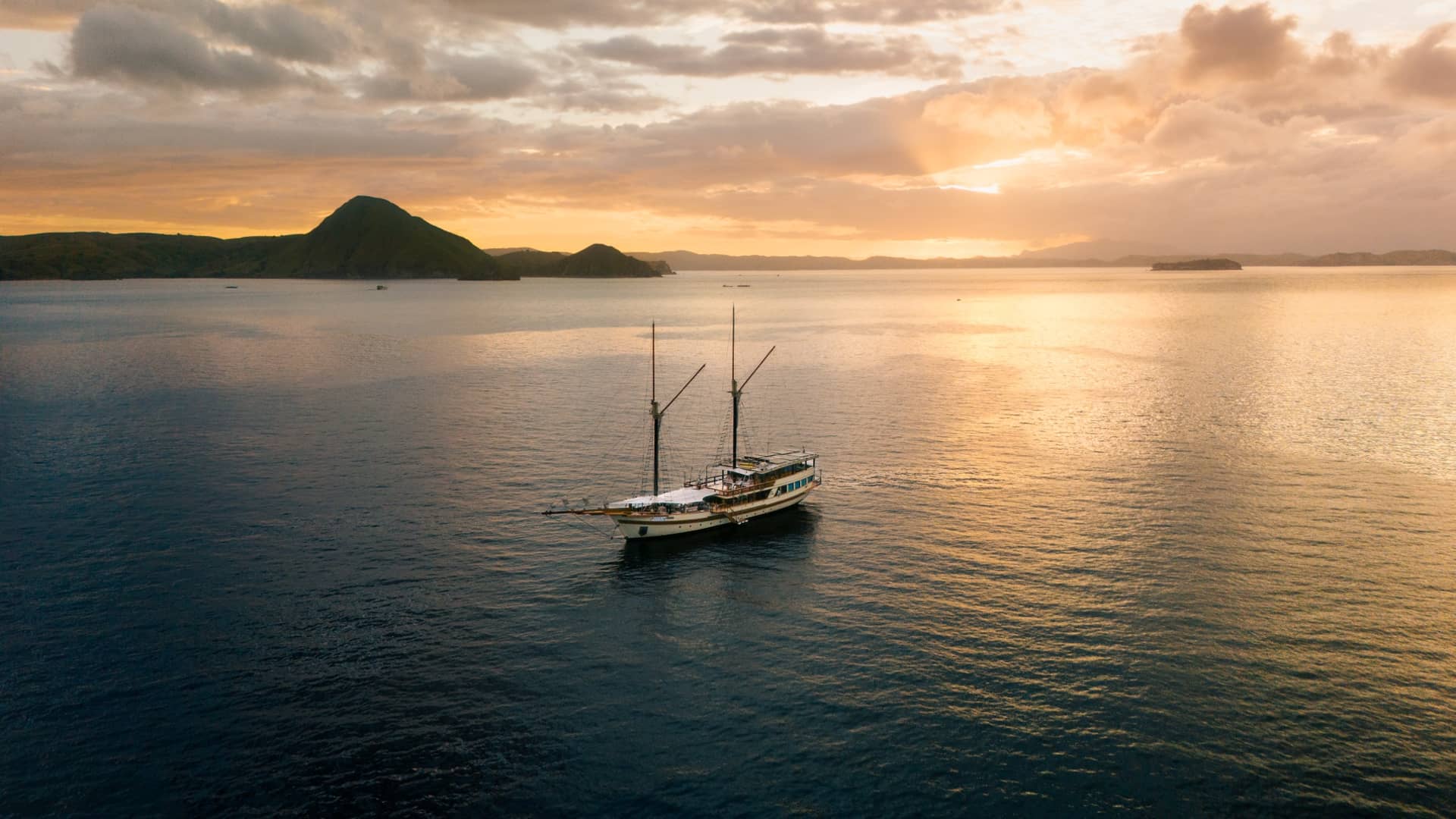
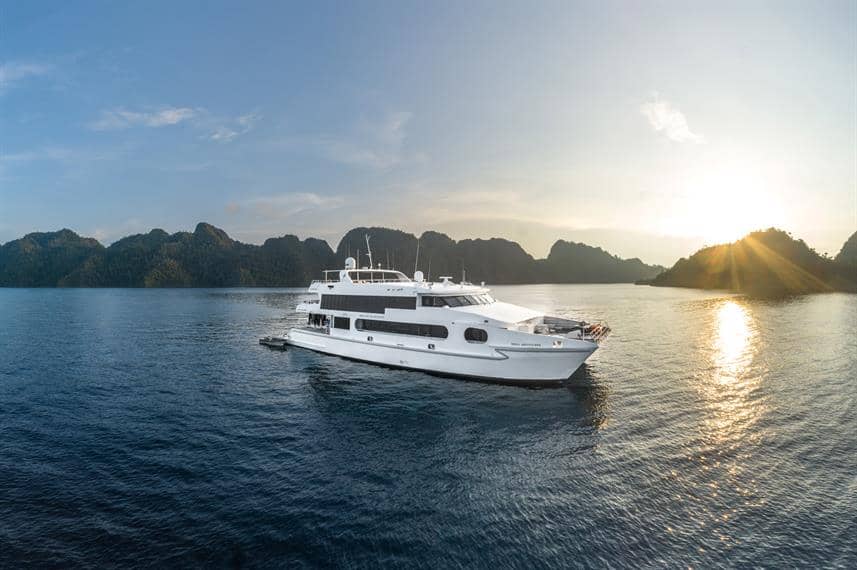
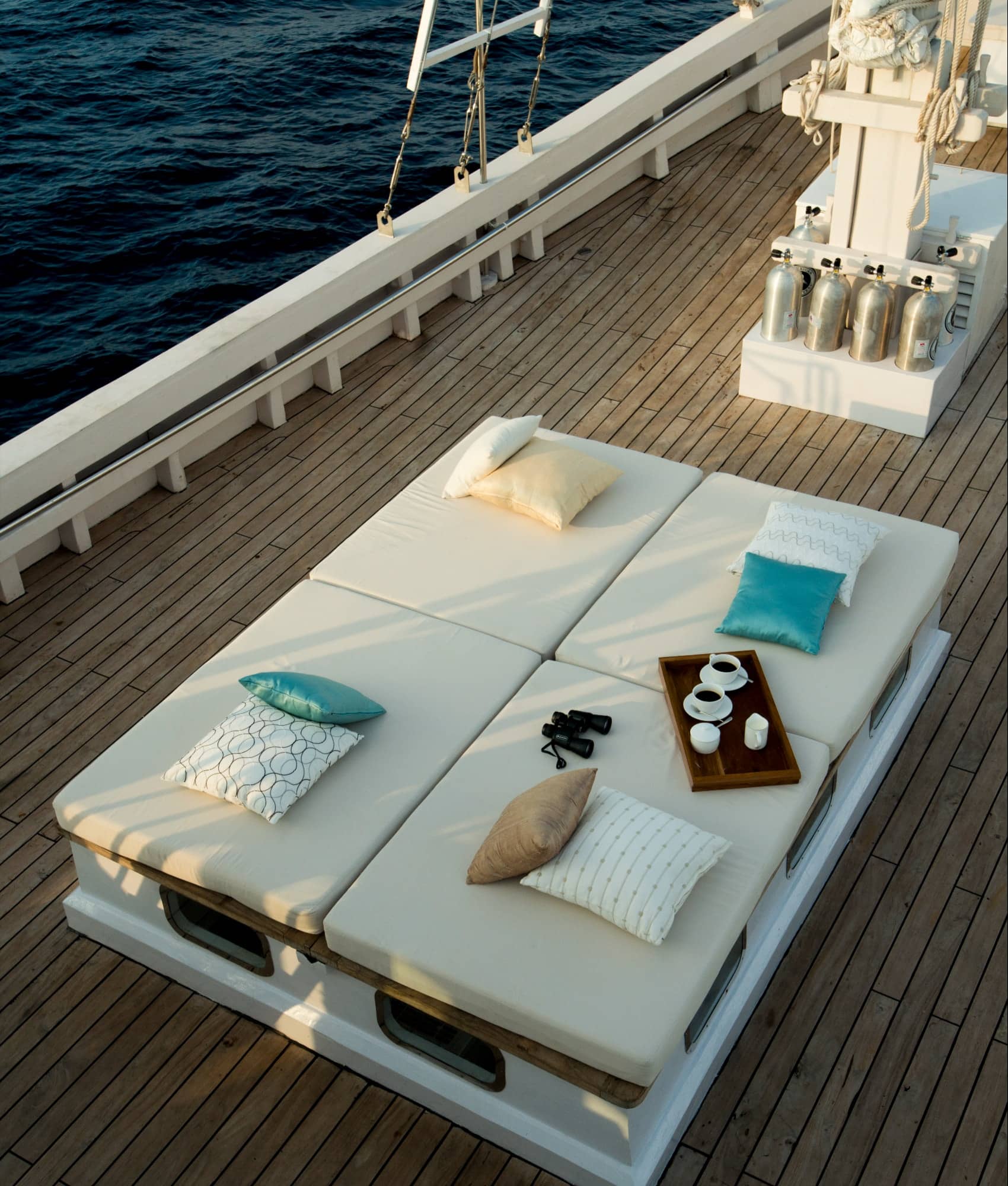
Alor is where the Lesser Sunda chain runs out. Past Flores, past Lembata, a scatter of steep volcanic islands sits either side of a narrow strait, and through that strait the Indian and Pacific oceans exchange water twice a day. That single fact makes Alor what it is: cold upwellings in a tropical sea, drift dives thick with fish, black-sand slopes crawling with things the size of a fingernail, and villages ashore where handwoven ikat and bronze heirloom drums still matter. It is one of the finest and least-visited diving grounds in Indonesia. It is also awkward to reach on its own, which is why an Alor charter is nearly always one movement of a longer voyage rather than a destination in itself.
Where Alor is, and why it stays quiet
The Alor archipelago lies at the far eastern end of East Nusa Tenggara, beyond Flores and Lembata, with the island of Alor and its neighbour Pantar facing each other across the strait that gives the ground its character. The main town, Kalabahi, sits at the head of a long bay on Alor’s western side and is where boats take on water and clear formalities. There is a small airport nearby with light connections via Kupang, but the schedules are thin and the practical way in is aboard the vessel you have chartered. That awkwardness is the reason Alor has stayed as it is. There is no resort strip, no fleet of day boats, and on most days at most sites the only tender in the water is your own.
On most days at most sites the only tender in the water is your own.
The Pantar Strait — the drifts
The strait between Alor and Pantar is the reason serious divers come. Tidal water funnels through it twice a day, and with it comes cold water from deep, so a dive here can begin in warm blue and pass through a thermocline that leaves you glad of a thicker suit. What that upwelling supports is biomass: walls and pinnacles around Pura and Ternate islands hung with fusiliers and jacks, reef sharks on the current line, and the sort of dense, moving fish life that has become rare elsewhere. It is not a beginner’s ground on the strongest days — currents run hard and can turn downward — so vessels here brief carefully, dive with an experienced guide and time sites to the tide rather than to the schedule. Handled properly it is exhilarating; handled casually it is not, and any good captain will say so.
Kalabahi Bay — muck, macro and the anemone fields
The other half of Alor’s reputation lies in the sheltered bay behind the town, where the bottom is black volcanic sand and the diving slows right down. This is muck diving — the patient kind, where a guide finds in forty minutes what you would never have seen in a week, and where the interest is in the odd and the tiny rather than the big and the blue. Alor’s celebrated shallow set-piece sits nearby: an expanse of anemones carpeting the slope with clownfish in every one of them, which divers know as Clown Valley and which snorkellers can enjoy just as well from the surface. After a hard drift in the strait, an afternoon on the sand is exactly the right counterweight, and it is one of the reasons the ground rewards several days rather than one.
Ashore — weaving villages and the Abui
Alor’s land is as interesting as its water, which is not true of every diving ground. The hills behind Kalabahi hold traditional Abui villages, of which Takpala is the one most often visited — steep-roofed bamboo and thatch houses on a terrace above the coast, and dances performed in the villagers’ own time rather than on a schedule. Along the coast at Alor Kecil and on the small islands offshore, ikat weaving is still worked on backstrap looms, the cloth tied and dyed thread by thread before a single line is woven. And in households across the archipelago sit moko — small bronze drums, heirlooms of uncertain age and considerable value, historically exchanged as bride price and still counted as family wealth. Shore visits here are arranged quietly through the crew, which is the only way they should be arranged.
Alor’s land is as interesting as its water, which is not true of every diving ground.
Volcanoes and crater lakes
Both Alor and Pantar are volcanic, and the interiors are steep, dry and dramatic in a way that surprises people expecting a low tropical island. Pantar carries the archipelago’s active cone, whose summit crater holds a lake, and hot springs surface in several places across the group — a reminder of what is going on underneath the water that makes the strait so cold and so rich. Whether any given crater walk is on your itinerary depends on the vessel, the weather and the state of the tracks; it is the kind of excursion a captain confirms locally on the day rather than promises in advance. What is certain is the view from the deck: volcanic islands falling straight into deep water, and very little sign of anyone.
Who Alor suits
Alor rewards guests who came for what is under the boat. Divers with some current experience will find it among the best water in Indonesia; photographers, particularly macro photographers, tend to run out of days before they run out of subjects. Snorkellers do well in the shallow anemone fields and the calm bays, though the strait itself belongs to divers. It is less suited to a party looking for beaches and shore life — the pleasures here are the drifts, the sand, the villages and the emptiness. Guests who want the headline sights of Indonesia in a compact few days are better served by Komodo, and those who want the richest reef on earth by Raja Ampat. Alor is the ground for the second or third trip, and people who come once tend to come back.
Alor is a leg, not a destination
Almost nobody charters Alor alone. It sits on the great east–west passage across eastern Indonesia, so it appears as a movement inside a longer voyage: eastward from Flores or Komodo towards the Banda Sea, or westward as a boat works back from the Spice Islands towards Komodo and Bali. A week in Alor by itself is possible on the right vessel, but the usual and better shape is ten to fourteen nights that take in the Alor strait and then carry on — which is exactly how the Banda Sea expedition is normally built. Plan the voyage first and Alor falls into place; plan Alor first and you will spend the trip fighting the geography.
When to go, and how to charter
We do not publish a separate Alor calendar, because in practice Alor’s dates are set by the voyage it belongs to rather than by a season of its own. If the passage runs on to the Spice Islands, the two Banda Sea windows govern everything — roughly April to May, and September to November — and the reasoning behind them is set out in our guide to when to sail the Banda Sea. If the passage runs west into Komodo National Park instead, that park runs roughly April to December and is calmest and clearest April to October. Give the desk your window and we will tell you which vessels are genuinely crossing Alor within it. An enquiry costs nothing and takes no card; once a boat is confirmed free the captain can hold your dates for up to fourteen days, and the rate, inclusions and terms — which vary from vessel to vessel — are put in writing before anything is paid.